Introduction
Biologics developers often face the complex task of managing Drug Substance vs Drug Product Comparability during a manufacturing shift. When you transition production to a new Contract Development and Manufacturing Organization (CDMO), the scope of your analytical studies naturally expands. A change in the Drug Substance (DS) process, such as a bioreactor scale-up, often cascades into the Drug Product (DP) phase. Regulators expect sponsors to prove that these changes do not alter the clinical safety or efficacy of the biologic.
This guide provides actionable tips for building a robust comparability strategy. We will explore:
- Scope Expansion: Why DS changes necessitate DP testing.
- Analytical Bridging: Tips for side-by-side molecular comparisons.
- Risk Management: Identifying red flags in the tech transfer process.
By mastering the Biologics Manufacturing Process Step by Step, you can better predict how a change in one phase expands the study requirements in the next.
Tip 1: Understand the Linkage Between DS and DP
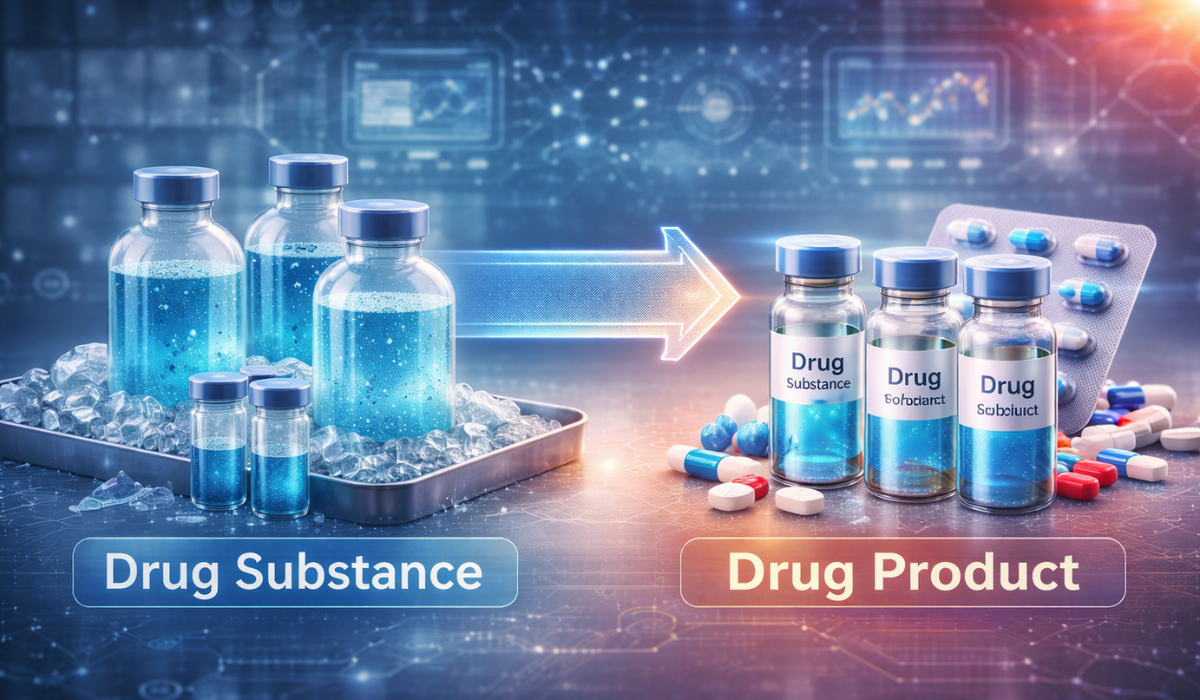
The most critical tip for sponsors is recognizing that Drug Substance and Drug Product are not isolated. The Drug Substance is the active ingredient, while the Drug Product is the final formulated medicine. If your CDMO changes the purification resin in the DS phase, it may impact the impurity profile of the DP.
A common mistake is focusing solely on DS characterization. Regulators often require “Finished Product” testing to ensure that the DS changes did not interact negatively with the formulation buffers. When defining your Biologics CDMO Outsourcing Strategy, always include a budget for expanded stability testing at the DP level to cover these potential shifts.
Tip 2: Map the Study Scope to the Magnitude of Change
Your study scope should directly reflect the risk of the change. A “Minor” change might only require DS release testing. However, a “Major” change—such as moving to a new CDMO—requires a full comparability exercise across both DS and DP.
Pro Tip: Use a “Risk-Based Approach.” Document why certain tests were included and others were excluded. This scientific justification is exactly what inspectors look for. If you are unsure of the magnitude, consult our guide on the Biologics Tech Transfer Process to identify high-risk variables.
The Impact of Scale-Up on Study Scope
Scaling up a bioreactor at a new CDMO is a primary driver of scope expansion. Larger volumes change the shear stress and oxygen transfer rates. These physical shifts can alter the post-translational modifications (PTMs) of the protein.
When Drug Substance vs Drug Product Comparability is at stake, you must test the DP for aggregates. Increased scale often leads to higher protein concentrations, which can trigger sub-visible particles in the final vial. If your CDMO does not have advanced imaging tools for particle analysis, your study scope will be fundamentally limited, potentially leading to regulatory delays.
Tip 3: Prioritize Analytical Bridging and Reference Standards
Successful comparability relies on having a “Source of Truth.” You must compare the “Post-Change” material directly against the “Pre-Change” reference material.
- Tip: Store enough “Pre-Change” Drug Substance and Drug Product before ending the relationship with your old CDMO.
- Tip: Perform “Side-by-Side” testing in the same laboratory. Using different labs for the old and new material introduces “inter-lab variability” that can mask real differences in the product.
This analytical rigor is a key part of Ensuring Quality, Safety, and Compliance Through Testing. Without a solid bridge, you cannot prove that the biologic remains the same.
Tip 4: Don’t Underestimate the DP Filling Process
Even if the Drug Substance remains identical, a change in the CDMO’s Drug Product filling line expands the scope. Different pumps, tubing materials, and sterile filters can introduce “leachables.” These are chemicals that migrate from the equipment into the medicine.
Sponsors must expand their Drug Substance vs Drug Product Comparability study to include “Extractables and Leachables” (E&L) testing. This is especially true if the new CDMO uses single-use technology (SUT). While SUT is efficient, it requires a unique validation scope to ensure no plastic-derived impurities enter the final patient dose.
Tip 5: Overlap Timelines for Accelerated Stability
One major timeline trap is waiting for long-term stability data before filing. To stay on track, use “Accelerated Stability” studies. Place your DS and DP in high-stress environments to see how they degrade.
Understanding How Long Biologics Manufacturing Takes is essential for planning. If you start your accelerated studies during the engineering runs, you can have preliminary comparability data ready by the time the first GMP batch is finished. This proactive planning prevents the DP release from becoming a bottleneck in your clinical program.
Tip 6: Focus on Critical Quality Attributes (CQAs)
You cannot test every single atom of a biologic. Instead, focus your study scope on the Critical Quality Attributes (CQAs). These are the attributes that impact patient safety and drug potency.
For a monoclonal antibody, your Drug Substance vs Drug Product Comparability scope should prioritize:
- Glycan Profiling: DS level.
- Potency Assays: Both DS and DP level.
- Charge Heterogeneity: DS level.
- Sterility and Endotoxins: DP level.
By narrowing your focus to CQAs, you make the study more manageable and the data more meaningful for regulators.
Red Flags in CDMO Comparability Reports
When reviewing data from your CDMO, watch for these red flags:
- Inconsistent Baseline Data: If the old material was tested using an older method version, the comparison is invalid.
- Narrow Statistical Ranges: If the CDMO sets the “passing range” too wide, regulators will accuse you of “masking” differences.
- Missing Forced Degradation: If the study doesn’t show how the product breaks down, you haven’t truly proved comparability.
Addressing these red flags early is a cornerstone of Biologics Tech Transfer to CDMOs: Risks and Best Practices.
The Economic Value of a Broad Study Scope
While expanding your study scope increases initial costs, it is a significant financial “Tip” for long-term savings. A robust comparability package reduces the likelihood of “Information Requests” (IRs) from the FDA. Each IR can delay approval by 3 to 6 months.
In the high-stakes world of biologics, a 6-month delay can cost millions in lost revenue and patient access. Think of a comprehensive Drug Substance vs Drug Product Comparability study as an insurance policy. It protects your program from the high cost of regulatory rejection.
Conclusion
In conclusion, managing Drug Substance vs Drug Product Comparability requires a proactive and scientific mindset. When switching CDMOs, you must accept that your study scope will expand to cover the biological and physical risks of the new facility. By following the tips outlined—prioritizing analytical bridging, focusing on CQAs, and mapping DS changes to DP impacts—you can navigate the transition with confidence. The goal of comparability is not to find “perfection,” but to prove “sameness.” With a well-documented and expanded study scope, you ensure that your therapeutic biologic remains a safe and reliable option for the patients who need it most.
Frequently Asked Questions (FAQs)
- Why does a change in Drug Substance affect the Drug Product study? The Drug Substance is the core ingredient. Any shift in its purity or structure can react differently with the DP formulation, potentially causing aggregation or loss of potency.
- What is the “Rule of Three” in comparability? It is a common industry tip to use three successful GMP batches to establish a statistical range for comparability, though regulators may ask for more for complex products.
- Can I use a rapid method for comparability testing? Yes, provided the rapid method is validated and shown to be equivalent to the compendial method used in the “Pre-Change” data set.
- What is a “Side-by-Side” test? This involves testing samples from the old process and the new process in the same lab, at the same time, using the same reagents to eliminate external variables.
- Does a new CDMO always mean a “Major Change”? For biologics, yes. Moving to a new manufacturing site is almost always classified as a “Major Change” (Prior Approval Supplement) due to the complexity of living cells.
- How long should I keep “Pre-Change” reference material? You should keep enough material to cover all comparability tests and potential “re-testing” needs for at least one to two years after the switch is approved.
References and Further Reading
- FDA Guidance: Comparability Protocols for Human Drugs: The definitive regulatory source for structuring comparability studies.
- ICH Q5E: Comparability of Biotechnological Products: The global standard for demonstrating sameness after manufacturing changes.
- Nature Biopharma: Bridging the Gap in CDMO Transitions: Practical insights on the technical hurdles of site switches.
- Journal of Pharmaceutical Sciences – Biologics Stability: Peer-reviewed research on DP stability after DS changes.
- ISPE Guide to Biopharmaceutical Tech Transfer: A comprehensive manual for managing the scope of CDMO transitions.
- PDA Technical Report No. 57: Analytical Method Transfer: Essential reading for the analytical side of comparability.


