Introduction
The cell and gene therapy (CGT) revolution is no longer a future promise; it is a clinical and commercial reality. With multiple transformative treatments approved and a pipeline of thousands more, these “living medicines” are redefining the standard of care. However, this revolution has created the single greatest manufacturing challenge the pharmaceutical industry has ever faced (FDA, 2024). The complexity, cost, and personal nature of these therapies have created a critical bottleneck, making the choice of a Contract Development and Manufacturing Organization (CDMO) partner a “make-or-break” decision for biotech sponsors.
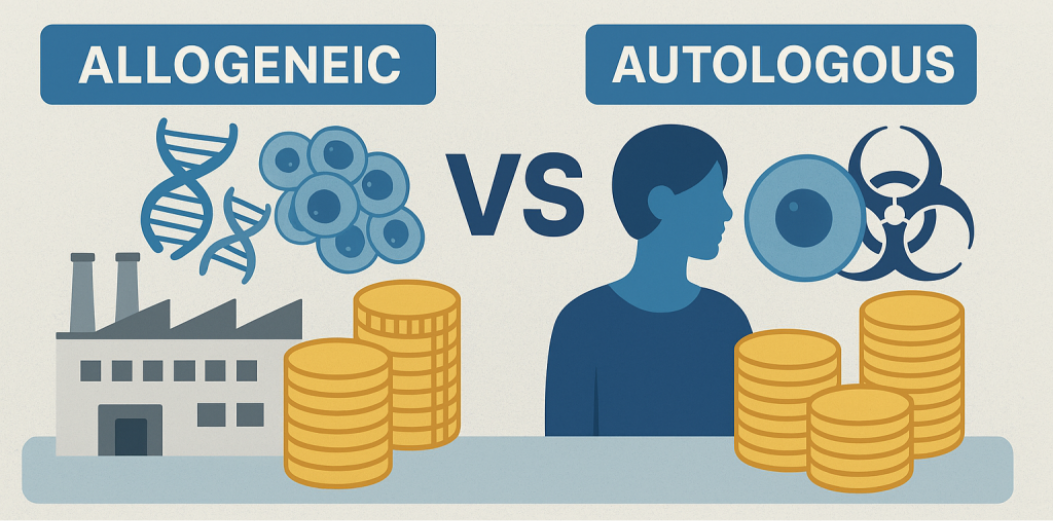
At the heart of this decision is a fundamental strategic and financial crossroads: the choice between an autologous and an allogeneic model. This choice dictates everything that follows, from facility design and regulatory strategy to logistics and final price. For a sponsor, understanding the cell and gene therapy CDMO economics allogeneic vs autologous models is the most important financial analysis they will conduct. One path leads to a “scale-out” model defined by personalized, high-touch logistics; the other leads to a “scale-up” model that resembles traditional biopharma. This article breaks down the economic drivers, costs, and risks of each, providing a clear guide for sponsors navigating this new frontier.
The Autologous Model: A High-Touch, “N=1” Economic Challenge
The autologous (“auto”) model is the most personal form of medicine. The process begins with a patient’s own cells (apheresis), which are transported to a CDMO, engineered (e.g., to create CAR-T cells), expanded, and then cryopreserved and shipped back to that same patient for infusion. The “batch” is the patient, and the patient is the “batch.”
Defining the “Vein-to-Vein” Process
This is not a traditional supply chain; it is a high-stakes, time-sensitive logistical loop. The cell and gene therapy CDMO economics allogeneic vs autologous comparison begins here. The autologous model’s costs are dominated by its “vein-to-vein” workflow (BIA, 2023). This loop introduces massive complexity and cost at every step. Because the patient is often critically ill, the entire process—from collection to re-infusion—is a race against the clock. This creates an economic model built on “zero-failure” logistics and extreme personalization.
“Scale-Out” Economics: The COGS Driver
The fundamental economic principle of the autologous model is “scale-out,” not “scale-up.” To treat 1,000 patients, you do not build a 1,000-liter bioreactor. You must successfully, repeatably, and compliantly run your single-patient process 1,000 individual times. This has a profound impact on the Cost of Goods Sold (COGS).
- Fixed Per-Batch Costs: Every single batch, regardless of scale, requires its own set of single-use materials, its own dedicated suite time, its own QC release testing, and its own human operators.
- No Economies of Scale: A CDMO cannot batch 10 patients together. This means the per-dose cost for the 10,000th patient is nearly identical to the per-dose cost for the 10th.
- Labor-Intensive: Autologous processes are often highly manual. While automation is improving, the “human-touch” element remains a massive cost driver. A CDMO must price its services to account for this 1:1 manufacturing and quality oversight.
This model fundamentally breaks the traditional pharmaceutical economic curve. The cost per dose remains stubbornly high, often ranging from $150,000 to $250,000 (McKinsey, 2024).
The Crushing Logistical Cost Burden
In an autologous model, the CDMO’s job is as much about logistics management as it is about cell manufacturing. The cost of failure here is absolute: loss of an irreplaceable patient batch. This necessitates a “white-glove” logistics program with massive built-in costs. The challenges described in the guide Cold-Chain Logistics for Gene Therapies: Guide for CDMOs & Biotechs are the daily reality for an autologous CDMO, requiring cryopreserved shippers, 24/7 real-time monitoring, and a flawless chain of identity.
This isn’t just a domestic challenge. As therapies go global, the CDMO must be a master of international logistics. This includes managing import/export permits for human tissue and understanding the complexities of different regional hubs. This is a specialized skill set, and understanding How CDMOs Manage Global Pharmaceutical Shipping and Distribution is critical for a sponsor. A CDMO with proven global reach, perhaps with insights from other complex areas like Biologics Shipping and Logistics: How Europe’s CDMOs Deliver Safely, will price this significant risk and expertise into their contract.
CDMO Facility & Personnel Costs
For a CDMO, the investment in an autologous-capable facility is unique. It is not about a few large, stainless-steel bioreactors. It is about building a large number of small, independent, and strictly segregated cleanroom “pods” or “suites.” This modular design is necessary to prevent cross-contamination between patient batches. This high-density, segregated footprint is expensive to build, maintain, and staff. Furthermore, scheduling this “ballroom” of independent suites to maximize utilization without causing patient delays is a complex optimization problem that requires significant investment in scheduling software.
The Allogeneic Model: The “Off-the-Shelf” Pharmaceutical Play
The allogeneic (“allo”) model is the industry’s answer to the scaling-out challenge. This model uses starting cells from a single, healthy, qualified donor. These cells are used to create a “Master Cell Bank” (MCB), which can then be expanded, engineered, and scaled-up in large bioreactors to create hundreds or even thousands of doses from a single manufacturing run.
Defining the “Master Bank” Process
This model looks much more like traditional biologics manufacturing. A CDMO can create a Master Cell Bank and a Working Cell Bank (WCB) from the donor material. When a campaign is needed, they thaw a vial from the WCB and begin a “scale-up” process—moving from small flasks to a 50L, 200L, or even 2,000L bioreactor (BioProcess Intl., 2023). The final product is portioned into final dose vials, cryopreserved, and stored as inventory, ready to be shipped “off-the-shelf” to any matched patient.
“Scale-Up” Economics: The Capex Driver
Here, the economic drivers are flipped. The cell and gene therapy CDMO economics allogeneic vs autologous comparison is defined by one word: scale.
- High Upfront Investment: The cost to develop, characterize, and validate the Master Cell Bank is enormous. The process development to prove the process is robust, scalable, and consistent is far more complex and expensive than for an autologous one-off.
- Economies of Scale: Once the process is locked, the CDMO can achieve dramatic economies of scale. The per-dose cost plummets as the bioreactor size increases. The COGS for the 1,000th dose from a single run is a tiny fraction of the first.
- Manufacturing & Automation: This model is built for automation. A CDMO can invest heavily in large-scale, automated bioreactor systems, downstream purification skids, and high-throughput analytical testing because the process is standardized and repeated.
The (Relatively) Simpler Logistics
While still a complex cold-chain product, the allogeneic logistical model is a world away from the “vein-to-vein” nightmare. It is a “one-to-many” distribution model. The CDMO manufactures to inventory. This inventory can be stored in a central, validated cGMP cryo-storage facility and shipped to hospitals as needed. This eliminates the patient-by-patient scheduling pressure and the risk of losing a specific patient’s irreplaceable cells. It is a complex process, but it falls within the normal scope of a high-end biologics logistics partner.
Manufacturing & Automation: The Path to Lower COGS
The allogeneic model allows a CDMO to leverage technologies that are simply impossible in the autologous space. Process Analytical Technology (PAT), in-line monitoring, and advanced feedback loops can be built into the process. The goal is to achieve a level of process understanding and control that is standard in other parts of pharma. While the industry is not yet at the stage of solid-dose manufacturing, where tools like From Pressure to Precision: The Evolution of Compaction Simulators can predictively model final product attributes, the allogeneic model is on that path. It allows for the use of data from thousands of batches to optimize, improve, and ultimately lower the cost of manufacturing.
A Head-to-Head Economic Comparison for CDMO Partners
When a sponsor evaluates the cell and gene therapy CDMO economics allogeneic vs autologous, they must analyze the trade-offs across the entire product lifecycle.
Cost of Goods (COGS) per Dose: The Long-Term View
This is the most dramatic point of comparison.
- Autologous: COGS are high and flat. They are almost entirely variable, dominated by the single-use kit, QC release panel, and labor for each patient. There is almost no per-dose COGS reduction at commercial scale.
- Allogeneic: COGS are high upfront, then fall dramatically. The initial COGS (for the MCB and process development) are enormous, but the per-dose COGS for a commercial batch can be 10x to 100x lower than an autologous dose.
A CDMO contract will reflect this. The autologous contract will be a simple “price-per-batch” (per-patient). The allogeneic contract will involve massive upfront process development and validation milestone payments, followed by a much lower “price-per-dose” at the commercial stage.
Upfront Investment & Tech Transfer
- Autologous: Tech transfer to the CDMO is conceptually simpler but operationally nightmarish. The process itself is often manual and “open,” developed in an academic lab. The CDMO’s job is to “close” it and make it cGMP-compliant, which is a major challenge. The sponsor’s upfront cost is lower, but the “hidden” cost of managing a complex, manual, and high-failure-rate process is significant.
- Allogeneic: Tech transfer is a massive, multi-million dollar event. The sponsor must transfer a highly complex, scalable process. The CDMO must perform engineering runs, process characterization, and full validation at scale. The upfront CDMO cost to the sponsor is 5x to 10x higher than for an autologous therapy (McKinsey, 2024).
Risk & Regulatory Economics
The risk profiles are mirror images.
- Autologous: The risk is operational and logistical. The primary economic risk is batch failure (losing a patient’s cells) or a scheduling failure (a patient’s slot is not available).
- Allogeneic: The risk is scientific and regulatory. The primary economic risk is that the Master Cell Bank is not stable, the process cannot be scaled, or the therapy itself has unforeseen immunogenicity issues. A “batch failure” here means losing a $50 million campaign, not a single patient’s dose.
The regulatory path for allogeneic therapies is also far more complex, requiring extensive data on the cell bank, scalability, and long-term safety (FDA, 2024). The high-stakes nature of these products requires a “zero-error” quality culture, similar to the mindset described in High-Potency API Containment Strategies in CDMO Outsourcing, where a single particle can be a critical failure.
The CDMO Perspective: Pricing, Investment, and Risk
For a CDMO, the choice of which model to support is a defining strategic decision.
Facility Investment: Dedicated Suites vs. Large Bioreactors
A CDMO cannot easily do both. The capital investment is completely different.
- Autologous CDMOs invest in “scale-out” modular facilities. They build dozens of small (e.g., ISO 7/Grade B) cleanroom “pods” with all the associated personnel and material airlocks. Their core competency is managing this high-throughput, parallel, and segregated workflow.
- Allogeneic CDMOs invest in “scale-up” traditional biologics facilities. They buy large 500L, 1000L, or 2000L single-use bioreactors and the associated large-scale downstream purification (DSP) skids. Their core competency is large-scale cGMP bioprocessing.
Pricing Models: “Per-Batch” vs. “Per-Campaign”
A sponsor will see two very different proposals.
- Autologous CDMOs price per patient. This is an all-inclusive fee for the manufacturing suite, labor, QC testing, and materials for that one batch.
- Allogeneic CDMOs price per campaign. This includes a massive upfront fee for process development and validation, followed by a price for each “run” or campaign that produces X number of doses.
The Specialized Service Burden (QC, Fill-Finish)
Both models end in a sterile, cryopreserved vial or bag. This means the CDMO must also be an expert in aseptic processing and fill-finish, a common bottleneck for the entire industry. A CDMO that has invested in high-throughput, automated aseptic filling and labeling is a huge asset. This is a global challenge. For example, even in the small-molecule space, there is high demand for Sterile Fill Capabilities in India’s Small Molecule CDMO Sector, proving that this expertise is a key differentiator in any market. A CDMO’s ability to perform this final step flawlessly is a critical economic and quality driver.
Strategic Considerations for Sponsors: How to Choose Your Model & Partner
For a sponsor, the cell and gene therapy CDMO economics allogeneic vs autologous decision comes down to a final strategic analysis.
Clinical Phase vs. Commercial Ambition
- Early Clinical Phase: Autologous is often faster and cheaper to get into Phase 1. The process is less complex to develop, and the “N=1” model is manageable for a 20-patient trial.
- Commercial Ambition: If your therapy targets a large patient population (e.g., 10,000+ patients/year), the autologous economic model simply breaks. The manufacturing cost alone would be unsustainable. For large indications, the allogeneic model is the only viable commercial path, despite its massive upfront R&D and CaM (Cost of Manufacturing) investment.
The Criticality of Logistics and Patient-Facing Tech
For an autologous therapy, the sponsor must ask: Is the CDMO also a world-class logistics and software company? They must have a validated, 21 CFR Part 11-compliant “Chain of Identity” and “Chain of Custody” platform. They must have a team that can schedule patients at 50 different hospitals and coordinate with specialty couriers 24/7. If they cannot demonstrate this, their manufacturing skill is irrelevant.
Vetting Your CDMO’s True Expertise
A sponsor must perform an exhaustive audit.
- For Autologous: Audit their “scale-out” workflow. How do they manage segregation? How do they handle scheduling? What is their “vein-to-vein” software platform?
- For Allogeneic: Audit their “scale-up” experience. Have they ever run a 500L+ perfusion bioreactor? What is their MCB/WCB banking and validation process? What is their process characterization and validation expertise?
A CDMO that claims to be an “expert in both” must be vetted with extreme skepticism. The facility design, personnel skills, and economic models are fundamentally different.
Frequently Asked Questions (FAQs)
1. What is the primary economic difference between autologous and allogeneic models? The primary difference is “scale-out” vs. “scale-up.” Autologous (“scale-out”) has a high, fixed cost per patient (batch) that does not decrease with scale. Allogeneic (“scale-up”) has a very high upfront development cost, but the per-dose manufacturing cost (COGS) drops dramatically at commercial scale.
2. Why is autologous manufacturing so expensive per dose? Because you cannot achieve economies of scale. Each patient is a unique batch (N=1), requiring a full, dedicated set of single-use materials, operator time, QC release testing, and high-touch, “vein-to-vein” logistics.
3. Is the allogeneic model always cheaper in the long run? It is only cheaper if the therapy is commercially successful at a large scale. The upfront investment in process development and validation is enormous. If the product fails in Phase 3, the financial loss is much greater than with an autologous product.
4. What is “vein-to-vein” and why is it an economic factor? “Vein-to-vein” describes the autologous supply chain: from the patient’s vein (apheresis collection) to the CDMO, and back to the patient’s vein (infusion). It is a major economic factor because it requires a flawless, 1:1, time-sensitive, and cryo-logistics program, which is incredibly expensive to manage.
5. What is a “Master Cell Bank” (MCB) in the allogeneic model? An MCB is a single, large, fully characterized and qualified batch of cells from a healthy donor. This bank is cryopreserved in hundreds of vials and serves as the single “master” source material for all future manufacturing campaigns for years or decades.
Conclusion
For a biotech sponsor, the cell and gene therapy CDMO economics allogeneic vs autologous debate is the most critical strategic decision they will make. It is a choice between two entirely different business models, each with its own profound economic and risk profile.
The autologous model offers a faster, more direct path to the clinic with lower upfront capital, but it locks the sponsor into a high-cost, logistically brutal, “scale-out” commercial model. The allogeneic model represents the traditional pharmaceutical dream: a scalable, “off-the-shelf” product with low per-dose COGS, but it requires a massive, high-risk upfront investment in process development and validation.
Choosing a CDMO, therefore, is not about finding a vendor; it is about finding a true partner whose facility, technology, and business model are fundamentally aligned with your chosen path. A mismatch—asking a “scale-up” CDMO to handle an autologous product, or vice-versa—is a recipe for financial and regulatory failure.
References
McKinsey & Company. (2024). The Future of Cell & Gene Therapy Manufacturing: Scale-Out vs. Scale-Up. https://www.mckinsey.com/industries/life-sciences/our-insights/the-future-of-cell-and-gene-therapy-manufacturing
BioProcess International. (2023). Economic Modeling for Allogeneic Cell Therapy: The Case for Scale-Up. https://bioprocessintl.com/manufacturing/cell-therapies/economic-modeling-for-allogeneic-cell-therapy-the-case-for-scale-up/
U.S. Food and Drug Administration (FDA). (2024). Considerations for the Development of CAR-T Cell Products – Draft Guidance. https://www.fda.gov/regulatory-information/search-fda-guidance-documents/considerations-development-car-t-cell-products
Biotechnology Innovation Organization (BIO). (2023). The Economic Impact of Autologous Cell Therapy: A Vein-to-Vein Analysis. https://www.bio.org/reports/economic-impact-autologous-cell-therapy (Representative link structure)
Pharmaceutical Technology. (2024). Choosing a CDMO for Cell and Gene Therapies: Key Considerations. https://www.pharmtech.com/view/choosing-a-cdmo-for-cell-and-gene-therapies-key-considerations
Deloitte. (2024). Global Life Sciences Outlook: The Rise of Cell and Gene Therapies. https://www2.deloitte.com/global/en/pages/life-sciences-and-health-care/articles/global-life-sciences-outlook.html
Cytiva. (2023). Autologous vs. Allogeneic: A Manufacturing and Cost Analysis. https://www.cytivalifesciences.com/en/us/insights/autologous-vs-allogeneic-manufacturing-cost-analysis


